
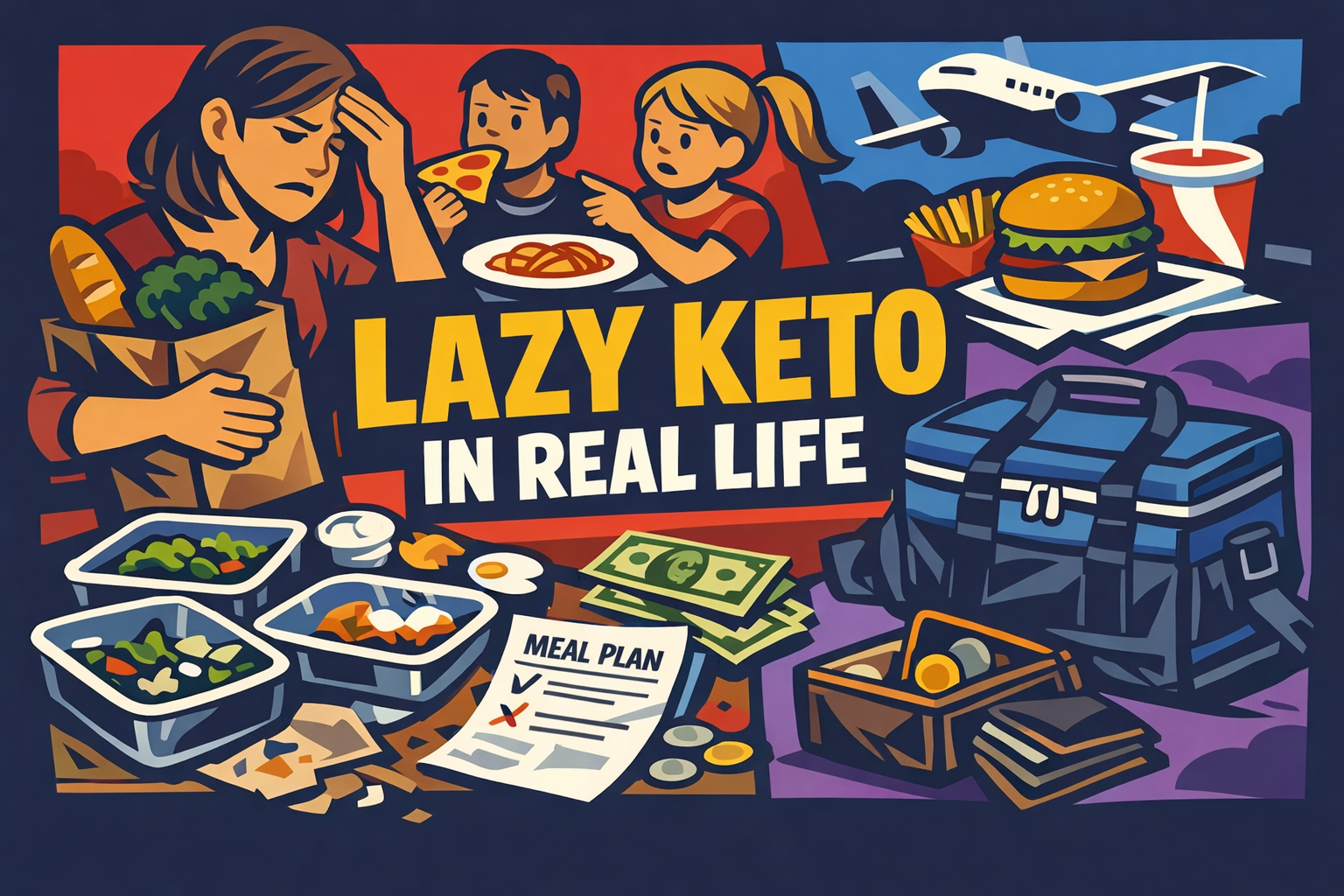
Lazy keto sounds easy until real life gets involved.
It works on calm days. Then family dinner changes, the grocery budget gets tight, meal prep falls apart, travel shows up, and suddenly your simple plan turns into random food decisions all day.
That is where a lot of people decide lazy keto only works in theory.
Here is the truth.
Lazy keto in real life fails for predictable reasons. It usually falls apart when home friction, out-of-house friction, or money-and-time friction starts making the food decisions for you.
That is why this page works best as a real-life failure map: a practical way to spot where your plan breaks, what to fix first, and where to go next.
Lazy keto does work in real life, but not if your version only survives perfect conditions. If the plan depends on a quiet kitchen, extra money, free time, and predictable days, it is fragile.
A real lazy-keto system has to survive the messy stuff: other people in the house, grocery weeks that stretch too long, food you forgot to prep, travel days with bad options, and nights when dinner starts going sideways at 5 PM.
The lazy keto in real life mistake: treating every messy week like a separate emergency
People often think they have five different lazy-keto problems.
Family meals are one problem. Tight budgets are another. Travel is another. Meal prep failure is another. Chaotic weeks are another.
Sometimes that is true. Usually it is one deeper issue showing up in different outfits: your plan has no strong defaults when normal structure disappears.
That is why the same person can feel fine on Sunday, sloppy by Wednesday, annoyed by Friday, and totally checked out by one travel day or one family event. The details change, but the system underneath is still too easy to break under pressure.
If you only eat well when you have plenty of time, a full fridge, and total control over the kitchen, the plan is not built for real life yet.
That is why pages like lazy keto that actually works, lazy keto meal rescue, and why keto keeps falling apart in real life matter so much. They shift you away from improvising and back toward dependable fallback systems.
Home friction: when family meals control the whole night
Family food pressure wrecks lazy keto fast because it is not just about carbs. It is about timing, mental load, and making one dinner work for multiple people.
You feed everyone else first. You pick at random things while cooking. Dinner gets later. Or you make one separate keto plate, feel annoyed, and then snack later because the meal never felt finished.
Sometimes the problem is not even your immediate family. It is houseguests, birthdays, school nights, sports events, or caregiving. Other people start running the food schedule, and your plan falls apart because it had no backup once the kitchen stopped revolving around you.
This is where most people get it wrong: they blame willpower when the real problem is that their meal only works if everyone else cooperates.
If that sounds familiar, start with keto when other people control the food and lazy keto with family, kids, and houseguests.
If your daily problem is more basic and happens at normal dinner time, focus on simpler family-meal defaults before you add more rules. One cooked protein, one easy side, and one backup plate you can make fast beats trying to win every dinner argument.
That is also where simple backup food matters more than motivation. If family nights regularly run late and you keep picking at random carbs while cooking, keeping a portable protein fallback like grass-fed beef sticks around can stop the whole night from turning into chaos.
Out-of-house friction: when travel or being away removes all your guardrails
A lot of lazy-keto plans work at home because home is doing half the work.
Your fridge is there. Your defaults are there. Your pans, your seasonings, your usual order of the day are there. Travel strips those supports away fast.
Then you see what your plan is made of.
Airports, hotels, gas stations, long drives, and weird meal timing all expose the same weakness: if your system has no portable version, you start eating whatever is easiest and promising yourself you will reset later.
That is why keto travel survival and lazy keto road trip food are such strong starting points. They cover the moments where “I will figure it out later” turns into six bad decisions in a row.
If airports and long days out are your main failure point, the fix is usually boring: pack first, improvise second. Even a basic travel food setup matters because it gives your plan a portable version instead of leaving you at the mercy of vending machines and terminal food. Shelf-stable options like zero sugar beef jerky work better than hoping airport food will magically line up with your plan.
Travel also hits electrolytes harder than people expect. Long drives, flying, restaurant food, missed water, and weird routines can all make hunger and cravings feel worse. If you keep getting sloppy on travel days because you feel drained and snacky, a simple packet of sugar-free electrolytes makes more sense than pretending the problem is only motivation.
Money and time friction: when the grocery budget gets tight and the whole plan gets sloppier
Budget pressure does not usually knock people off track in one dramatic moment. It works more quietly than that.
You stop buying the foods that make the week easier. You buy more cheap convenience food because it feels safer in the moment. You stretch groceries too far. The fridge starts looking full of pieces instead of meals. By the end of the week, the plan is running on leftovers, snack food, and whatever is cheapest and fastest.
This is where people start telling themselves that keto is too expensive. Sometimes that is true. A lot of the time it is partly a systems problem. The money issue is real, but the bigger problem is that your cheap foods are not organized into reliable meals.
That is why lazy keto on a budget, why lazy keto falls apart the week before payday, and budget keto troubleshooting are useful. They help you make the plan cheaper without turning it into random low-carb junk.
If the week-before-payday stretch is where everything really falls apart, treat that as a system problem early instead of waiting for the kitchen to go empty. Cheap food still has to become real meals.
Money and time friction again: when meal prep fails and dinner starts collapsing by midweek
A lot of people think they are bad at lazy keto when they are really bad at overcomplicated prep.
They prep like it is a project. Then life changes, they miss a day, the containers get ignored, and by Wednesday the system is dead. After that, every meal feels like a fresh decision again.
Real lazy keto does not need perfect prep. It needs default proteins, backup meals, and enough carryover to keep one rough day from wrecking the next three.
That is exactly what lazy keto meal prep that actually survives real life is built for. And if your cart keeps looking decent but somehow never becomes a real plan, lazy keto grocery systems helps fix that missing link.
The mistake here is expecting motivation to carry the week. The fix is making sure your kitchen keeps producing easy meals after your motivation disappears.
If you always hit Thursday with nothing ready, this is the moment to build a rescue layer, not a more ambitious prep system. Keep one freezer meal, one fast protein, and one “too tired to think” dinner option ready so a missed prep day does not automatically turn into takeout.
How to tell which lazy-keto problem you actually have
Here is the fast filter.
- If nights blow up around other people: it is usually a family-food or schedule-control problem.
- If the week gets messier as groceries run low: it is usually a budget plus grocery-system problem.
- If the plan dies after one missed prep day: your meal prep is too fragile.
- If you do fine at home and sloppy everywhere else: your system is not portable yet.
- If random food decisions keep happening when you get hungry out of the house: you have a backup-food problem, not just a motivation problem.
The mistake is trying to solve all of them with one vague promise to “be more prepared.” That sounds useful but does not tell you what to change first.
The lazy-keto framework that survives real life
A real lazy-keto system usually has five parts.
First: default meals that are boring enough to repeat and solid enough to hold you.
Second: backup foods for when the normal plan misses. Not snack chaos. Actual fallback meals.
Third: a grocery system that buys parts for meals, not just ingredients that seem keto.
Fourth: a portable version of the plan for travel, errands, appointments, and long days out.
Fifth: a family and social strategy that assumes you will not control every meal environment.
If one of those is missing, lazy keto starts feeling fake. If all five exist, the plan feels much calmer even when life is not.
That framework also keeps you from overreacting every time a week goes sideways. A missed prep day should not destroy dinner for the next three nights. One cheap grocery run should not leave you with nothing but snack food. One hotel stay should not turn into four days of random eating.
That is what makes lazy keto feel light instead of fragile. You do not need endless options. You need a few repeatable ones that still work when your mood, schedule, kitchen, and budget are all less helpful than usual.
Where to go next instead of starting over again
If this post sounds like your life, do not restart from scratch. Route yourself to the real problem.
- Family meals, kids, or houseguests keep hijacking dinner: go to lazy keto with family, kids, and houseguests.
- Travel days and out-of-house chaos keep turning into random food decisions: go to keto travel survival.
- The week gets worse as time, groceries, and money run down: go to budget keto troubleshooting.
- You need faster fallback meals before the whole night goes sideways: go to lazy keto meal rescue.
Reality check: lazy keto is not supposed to mean thoughtless keto
Lazy keto should reduce friction. It should not remove structure completely.
A lot of people hear lazy and assume the plan should run itself forever with no defaults, no backups, and no adjustment for messy weeks. Then they feel betrayed when life gets complicated and the whole thing slips.
That is not proof lazy keto failed. It is proof the system was too light in the places where real life gets heavy. The goal is to make the easy choice easy enough that normal chaos does not immediately push you into random carbs and random snacking.
Fix this first:
- Pick the one real-life situation that breaks your plan most often: family dinners, tight grocery weeks, travel, or missed meal prep.
- Build one default backup for that situation before you try to overhaul the whole week.
- Make sure your groceries create repeatable meals, not just a pile of keto ingredients and snacks.
- Give your plan a portable version for days when home is not doing the work for you.
- Use the right next-step page instead of restarting from zero every time the week gets messy.
Start with the next page that matches your real problem:
- Family meals, kids, and houseguests
- Travel days, hotels, airports, and long days out
- Budget pressure, grocery gaps, and end-of-week sloppiness
- Fast backup meals when dinner is about to collapse
- See the bigger real-life breakdown pattern here
Explore more Lazy Keto stories here: