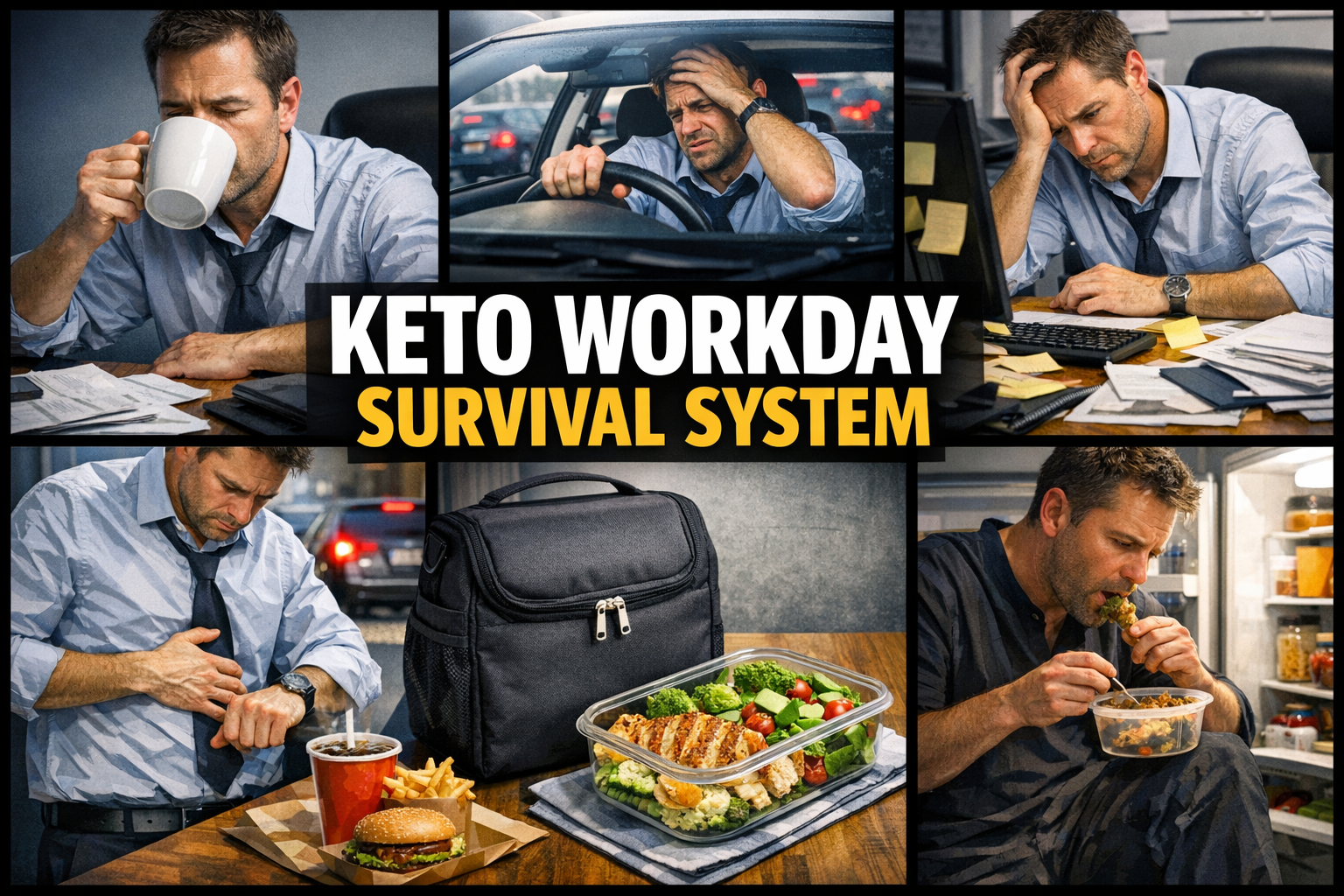
You are not failing keto because you work.
You are failing because the workday keeps changing the rules, and your food plan keeps acting like every day is the same.
This is not a meal list and it is not a giant directory.
This is the keto workday survival system. The goal is simple: stop letting coffee, commutes, missed meals, stress, and late-night recovery eating run the whole week.
If keto only works on calm days, it does not really work yet.
The real problem is not one bad meal. It is a broken workday pattern.
Most people keep treating workday keto like a food-choice problem. It is usually a sequence problem.
The day starts rushed, caffeine takes over, lunch gets delayed, backup food is weak, and dinner becomes cleanup. Then people blame carbs, motivation, or a lack of discipline.
That is backwards. The system broke before dinner even showed up.
If your home days and work days feel like two different lives, start with the work-from-home breakdown and the hybrid office day pattern.
Those two pages show the same truth from different angles: your food plan cannot depend on one environment staying stable.
Start here:
Coffee-first mornings create fake control
A lot of workday keto problems start with a morning that looks clean but is actually unstable.
You are not hungry. You have coffee. You tell yourself you will eat later. That feels disciplined until later keeps moving.
Real-life version: you leave the house with caffeine in your system, no real plan for lunch, and just enough confidence to make a dumb decision by 2 PM.
This is where early-start keto mornings and the morning-to-night breakdown matter. They explain why a smooth morning can be a lie when it is built on delay, not stability.
Common mistake: judging the day by how easy it felt before noon. Fix: judge it by whether the day still feels manageable at 4 PM.
No-lunch days are usually not about willpower. They are about no default.
This is where keto workdays get stupid fast.
If your lunch plan depends on extra time, a perfect mood, a clean fridge, or a helpful break schedule, you do not have a lunch plan. You have a fantasy.
That is why people end up doing one of four things: skipping lunch, piecing together random snack food, promising themselves they will eat later, or turning a gas-station stop into dinner pregame.
The cleaner fixes live in the lunch backup page and the work lunch system.
Real-life version: you open your bag and realize the only thing in there is something light, cold, or boring enough that you do not really want it. Now the whole day is negotiating with the vending machine, the break room, or the drive home.
This is one place where a simple backup can save the day. A ready-to-drink protein shake or a pack of beef sticks is not magic food. It is just better than reaching late afternoon with nothing useful in you.
Common mistake: treating lunch like a moral test. Fix: make lunch boring in a good way. Predictable. Filling. Easy to repeat.
Commute days break keto when the gap between meals gets too long
Commute days are not just office days with extra driving. They create dead zones where you cannot cook, cannot stop easily, and start making food choices from the driver seat.
That matters because commute hunger rarely shows up politely. It hits late, it hits fast, and it makes convenience food look smarter than it is.
If that is your pattern, go to the commute day guide and pair it with fast food keto survival.
Real-life version: the workday ran long, traffic is bad, and now you are telling yourself a bunless burger plus three extra little things is still fine because at least it is low carb.
The carb count is not always the only problem. The bigger problem is decision mode. Once the commute turns into a hunger tunnel, portion control, patience, and common sense usually get worse.
Common mistake: assuming you can just tough it out until home. Fix: treat the commute like part of the eating schedule, not the empty space between work and dinner.
At-home workdays fail because access replaces structure
Work-from-home days look easier. A lot of the time they are not.
At home, the food is always there. The kitchen is close. Meetings happen next to your pantry. Leftovers, bites, and “I will just have something small” choices start blending together.
That is why some people under-eat all morning, while other people graze all day and still end up unsatisfied. Different behavior. Same problem. No clear meal structure.
If that sounds familiar, start with the work-from-home guide and the hybrid office page.
Real-life version: you make coffee, answer messages, grab cheese, pick at leftovers, skip a real lunch, then wonder why dinner feels huge even though you were around food all day.
Common mistake: thinking proximity to food solves the workday. Fix: keep the same meal anchors you would need outside the house. Access is not a system.
Meeting-heavy days quietly erase the middle of the day
This is one of the biggest workday problems because it does not feel dramatic while it is happening.
You are not doing anything wild. You are just taking calls, jumping into meetings, and pushing food decisions back one hour at a time.
Then you look up and realize it is 3 PM, your brain feels flat, and now the rest of the day is being run by catch-up hunger.
This is where video-call days, deadline days, and errand-day keto fit into the same bigger pattern: if the day gets packed, your meals must get simpler, not more ambitious.
Real-life version: you plan to cook eggs at noon, a call runs long, you grab coffee instead, and by late afternoon you are staring at the fridge like it betrayed you.
Common mistake: building a lunch plan that requires a real break. Fix: give busy days a shorter version of lunch you can use without needing a perfect window.
After-work eating is often unfinished workday damage
A lot of people think after-work overeating is only emotional. Sometimes it is emotional. A lot of the time it is emotional plus biological plus logistical piled together.
You are tired. Meals were weak. The day took more out of you than expected. Now the kitchen feels like relief.
The after-work stress eating post matters here because it does not pretend one deep breath fixes a wrecked day.
And if your broader problem is that the whole plan keeps collapsing under normal life pressure, the real-life lazy keto survival guide helps connect the full pattern.
Real-life version: dinner is not just dinner anymore. It is the emotional receipt for coffee, delays, missed meals, traffic, and every half-decision the day forced on you.
Common mistake: trying to solve night eating with stricter rules after dinner. Fix: reduce how much unfinished hunger and unfinished irritation arrive at dinner in the first place.
Build your default weekday system before you chase variety
This is the part most people skip.
They want better motivation, better tracking, better snacks, or more meal ideas. What they usually need first is a repeatable weekday structure.
Your system does not need to be fancy. It needs versions.
- Home day default: what breakfast and lunch look like when you are near your kitchen all day.
- Commute day default: what happens before the drive gets long and hunger gets louder.
- Meeting-day default: what lunch becomes when your break disappears.
- Late-day backup: what you use before fast food becomes the whole plan.
If every weekday uses a different food system, the whole week gets harder than it needs to be. Home day food. Office day food. Errand day food. Deadline day food. Your brain burns out before your body does.
That is why a good workweek plan is not one perfect menu. It is a small set of defaults you can repeat without drama.
The workday survival system in plain English
Here is the framework.
First, stop treating all workdays the same. A home day, office day, commute day, meeting-heavy day, and no-lunch day need different versions of the same core structure.
Second, make your first real food decision earlier than your emergency window. If your first useful food choice happens only after you are already tired and hungry, the workday is already driving.
Third, give lunch a default, not an aspiration. The point is not variety. The point is stability.
Fourth, carry one level of backup more than you think you need. Not because you are weak. Because workdays change fast.
Fifth, stop acting surprised when night eating follows a sloppy day. It usually makes perfect sense.
This is what turns keto from a calm system into a weekly drama. The food is part of it. The bigger issue is that your schedule keeps making the important decisions too late.
Related:
Reality check
You do not need a harder keto plan. You need a workday plan that still works when the day gets annoying.
The point of this page is not to make you perfect at meal prep or obsessed with carrying containers everywhere. The point is to stop losing the week to the same sequence: rushed start, weak middle, hungry commute, messy night, restart tomorrow.
If you keep solving work problems one meal at a time, you will keep missing the system failure underneath them.
Workday keto gets easier when fewer decisions happen late, fewer meals depend on ideal conditions, and fewer nights are asked to repair damage from the whole day.
Fix this first:
- Pick the weekday pattern that breaks keto most often: work-from-home, commute, meeting-heavy, no-lunch, or after-work eating.
- Create one default lunch and one backup lunch for that pattern so the middle of the day stops depending on luck.
- Move the first real meal earlier if coffee keeps replacing breakfast and pushing hunger into the afternoon.
- Set one late-day rescue before the commute home starts so fast food stays an emergency option instead of the weekly system.
- Build a tiny weekday system with versions for home days, office days, and overloaded days before you chase more variety.
If this helped, start with these next:
- The video-call day guide for workdays that lose lunch without looking messy
- The work-from-home guide for days when easy access turns into random eating
- The hybrid office guide for weeks that keep switching environments on you
Explore more Lazy Keto stories here: