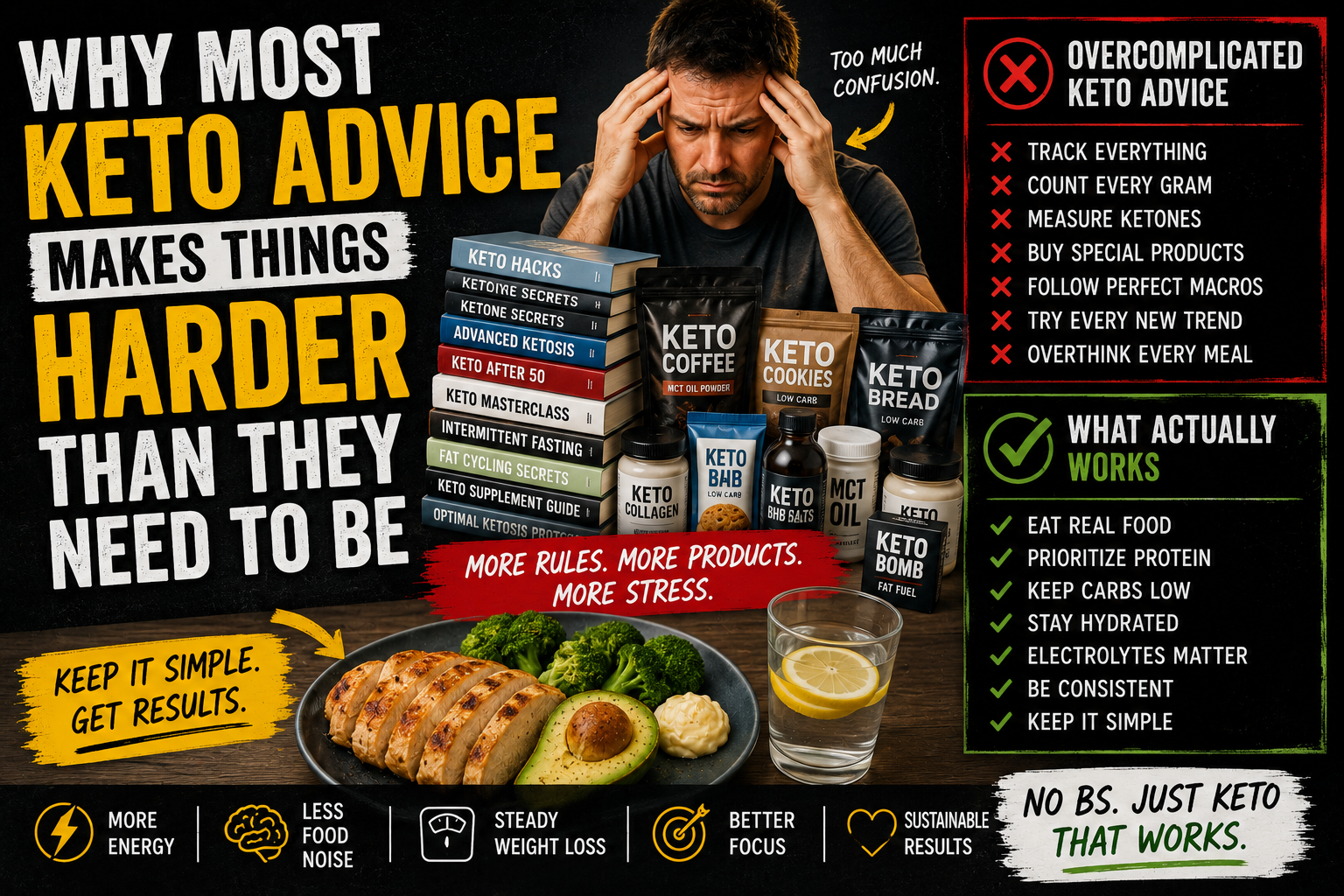
Most keto advice makes things harder than they need to be.
You start out trying to keep carbs low and eat better. Then the internet turns it into a full-time job.
Now you’re reading labels for an hour, buying “keto” junk food, worrying about ketone numbers, and wondering why this still feels harder than it should.
That’s not because keto is impossible.
It’s usually because bad keto advice keeps pushing people toward complexity instead of results.
Here’s the truth: most people do not fail because they need more advanced keto tricks. They fail because they keep getting pulled away from the basics that actually make keto work in real life.
Why Most Keto Advice Backfires
A lot of keto content sounds smart but creates the wrong priorities.
Instead of helping you eat in a way that keeps you full and consistent, it pushes you toward numbers, products, hacks, and fake convenience.
That matters because keto only gets easier when your day gets simpler.
If your version of keto makes you think about food all day, second-guess every meal, and rely on snack products to hold things together, that is not a better plan. It is a fragile one.
The usual pattern looks like this:
- You start with good intentions.
- You absorb ten different rules from ten different people.
- You build meals around low-carb marketing instead of real food structure.
- You get hungry, inconsistent, or annoyed.
- You assume you need even more keto advice.
That loop is where most people get stuck.
Cause #1: You Start Trusting Labels More Than Food
This is one of the fastest ways keto gets harder than it needs to be.
A lot of bad keto advice teaches people to shop by packaging. If the box says keto, low net carb, sugar free, or high fat, it starts feeling safe automatically.
But that is how people end up building a whole day around bars, wraps, shakes, desserts, and “healthy” snack food that still keeps them hungry or overeating.
In real life, it looks like this: breakfast is a keto bar, lunch is a low-carb tortilla wrap, the afternoon turns into flavored nuts or candy-style treats, and dinner feels out of control because none of the earlier food really held you.
The common mistake is thinking low carb automatically means helpful.
It doesn’t.
Some keto products are fine as backup food. A lot of them just make it easier to keep eating all day while telling yourself you’re still being disciplined.
What to do instead: let simple food do the heavy lifting. Build more meals around protein and fewer around branding. Meat, eggs, Greek yogurt if it works for you, leftovers, burgers without the bun, chicken, tuna, steak, and simple sides will usually do more for appetite control than “keto” snack products.
If you keep getting fooled by clean-looking packages, read The Net Carb Trap Map and Sugar Alcohols and Fake-Sweet Keto Foods. Those two problems alone explain a lot of “I’m low carb but this still isn’t working” frustration.
Cause #2: You Keep Chasing Keto Treats and Fancy Shortcuts
A lot of keto advice is really just snack marketing in disguise.
It tells you that the answer is another dessert, another replacement product, another coffee trick, another sweet thing that is technically allowed.
That sounds easier. Usually it is not.
When your plan depends on recreating cereal, cookies, ice cream, candy, bread, and fast comfort food in keto form, you stay mentally locked into the same eating rhythm that caused problems before. You just change the labels.
In real life, this shows up when someone says they are doing keto but still needs something sweet after dinner every night, still wants crunchy snacks in the afternoon, and still keeps a drawer full of “safe” treats nearby.
The mistake is treating keto products like a foundation instead of a backup option.
That usually keeps cravings louder, portions sloppier, and food thoughts more constant.
The fix is to stop asking, “How do I keto-fy every craving?” and start asking, “Why does this part of my day keep falling apart?”
If dinner never fills you up, the problem may be meal structure. If late-night eating keeps happening, the problem may be an underfed afternoon. If you keep needing treats, the problem may be that your food still revolves around reward instead of enough protein and enough real meals.
That’s why Beginner Keto Fix Map works better than random hacks. It points you back to the broken part of the routine instead of sending you to another product.
Cause #3: Bad Keto Advice Still Makes People Under-Eat Protein
This is where a lot of “eat more fat” advice goes off the rails.
Yes, keto is low carb. No, that does not mean you should build your day around butter, fat bombs, coffee drinks, and tiny protein portions.
When protein is too low, keto gets harder fast.
You stay hungry longer. You think about snacks more. You start grazing. Then you assume the answer is more willpower, more fat, or more keto products.
In real life, this is the person who has coffee for breakfast, a light salad with not much meat for lunch, then acts surprised when the evening turns into cheese, nuts, sweeteners, and random bites from the kitchen.
The mistake is confusing “high fat” with “satisfying.”
Fat can help with meals, but weak protein is one of the main reasons people feel like keto is unstable. If meals do not anchor hunger, the rest of the day gets messy.
The fix is simple: make protein more obvious and harder to miss.
Instead of asking whether a meal is keto enough, ask whether it is built around a real protein source. Eggs. Chicken. Beef. Turkey. Fish. Cottage cheese if you tolerate it. Greek yogurt if it works for your goals. Leftover meat. Bunless burgers. Deli meat plus something more solid than a few snack bites.
If you need a practical backup for chaotic days, keep something simple and protein-forward around instead of another fake dessert. Options like grass-fed beef sticks or a basic ready-to-drink protein shake make more sense as rescue food than another low-carb treat.
For a deeper breakdown, read Keto Meal Structure That Actually Keeps You Full. That is where keto gets easier for a lot of people.
Cause #4: Most Advice Ignores Real-Life Structure
This is the big one.
A lot of keto advice assumes you live in a perfect food lab where you have time to cook every meal, never get stuck in traffic, never work late, never deal with kids, never get hit with stress, and never have to grab food on the go.
That is not real life.
Real life is where keto either survives or falls apart.
You can know every rule and still struggle if your day has no structure. You skip lunch because you were busy. You leave the house underfed. You rely on “something keto” from a gas station. You get home starving. Then the night becomes one long food decision.
The mistake is thinking information alone fixes routine problems.
Usually it doesn’t.
The fix is to build fewer decisions into your day.
- Have 3 to 5 repeat meals that work.
- Keep 1 or 2 emergency foods that are actually filling.
- Know what you order when you are out.
- Stop pretending every day will be a perfect cooking day.
That is also why some people do better with boring meals than with endless keto creativity. Boring is underrated when it keeps you consistent.
If your problem is not knowledge but daily friction, that is the kind of issue covered in Beginner Keto Fix Map and the site’s more practical fix posts. The real question is not “What is the perfect keto method?” It is “What setup can I repeat on my worst weekday?”
Common Keto Advice Mistakes That Waste Time
Here is where people usually make the whole thing harder:
- They spend more time reading about keto than repeating good meals.
- They chase ketone numbers while ignoring hunger, portions, and routine failures.
- They keep buying packaged keto foods instead of fixing weak meal structure.
- They treat snacks and treats like a meal plan.
- They expect motivation to solve problems that structure should solve.
None of that means tracking is always bad, keto products are always bad, or convenience is always bad.
It means those things are tools, not the foundation.
If the foundation is weak, more tools just make the mess more expensive.
What To Do Instead If Keto Feels Too Complicated
If keto advice has turned your brain into a mess of rules, strip it back down.
Start with meals that do one job well: keep you full, keep carbs low enough, and reduce the urge to keep eating.
That means your best moves are usually boring:
- a protein-first breakfast instead of coffee and vibes
- a real lunch instead of snack food with keto branding
- a repeatable dinner instead of nightly improvising
- backup foods for schedule crashes
- fewer sweet “keto” extras that keep appetite noisy
Once that is working, then you can decide whether tracking, ketone testing, fasting, or other tools actually help you.
But do not start there.
Start where your real problems are.
Related:
FAQ
Is most keto advice actually wrong?
Not always wrong. A lot of it is just badly prioritized. It pushes advanced tactics, packaged foods, and complexity before the basics are working.
Do beginners need to track everything?
Some beginners benefit from short-term tracking, but most need clearer meals more than endless data. Tracking is a tool, not the whole strategy.
Are keto snacks always bad?
No. They become a problem when they replace real meals, keep cravings active, or turn your day into constant grazing.
Why does keto still feel hard even when I am staying low carb?
Usually because the plan is low carb but not stable. Weak protein, fake convenience, snack-heavy meals, and bad structure can keep keto feeling harder than it should.
Fix this first:
- Pick 3 repeat meals built around real protein, not keto packaging.
- Cut back the treat-style keto products that keep you thinking about food all day.
- Use low-carb products as backup tools only, not as your main plan.
- Fix the part of the day that keeps breaking instead of chasing another hack.
Read next:
Bottom line: Keto gets easier when you stop chasing hacks and start repeating simple, protein-first meals you can actually stick to.