
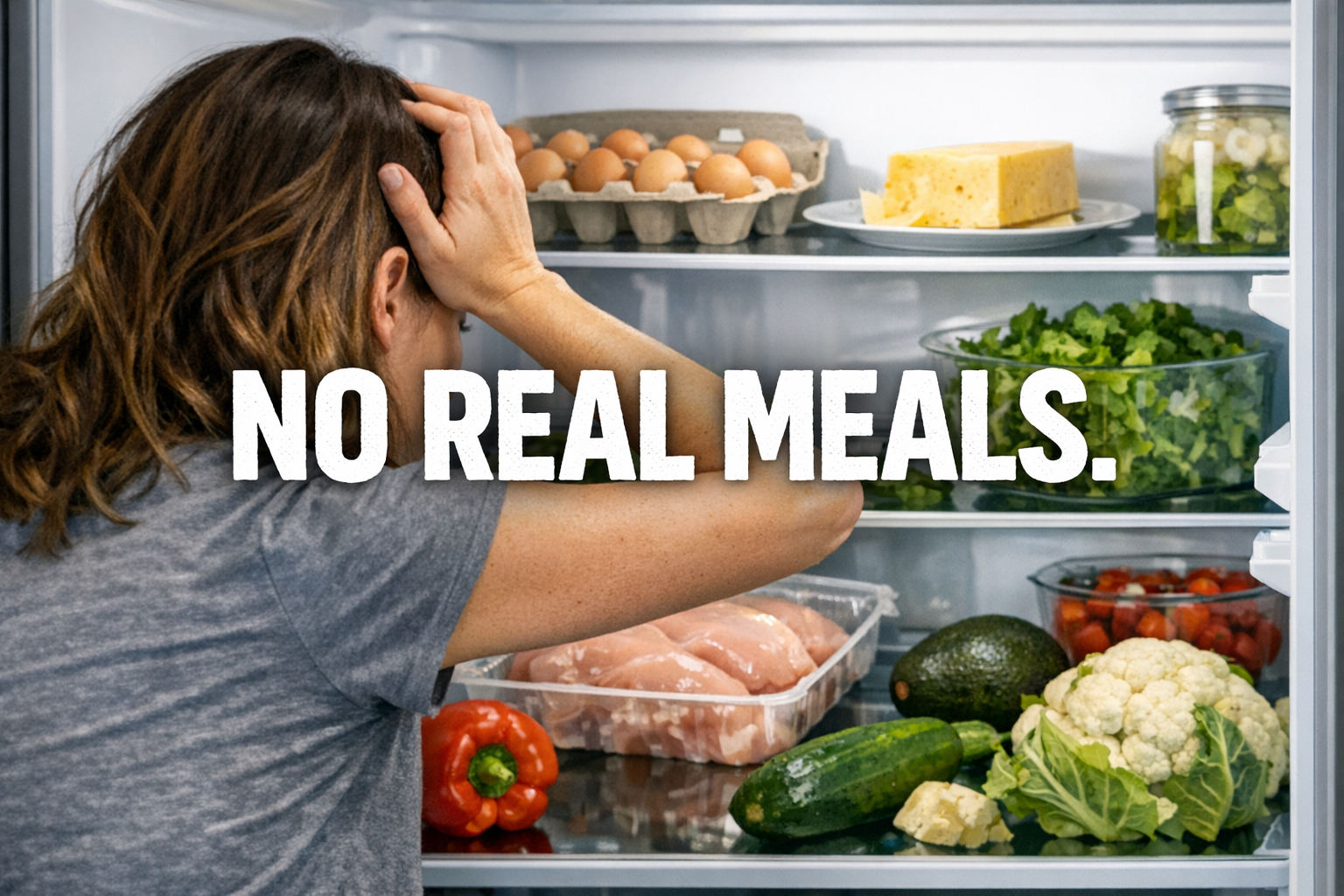
You bought the chicken, eggs, cheese, and vegetables. Your carbs still look low. But lazy keto ingredients not meals is where a lot of people get stuck.
On paper, it looks like you have keto food at home. In real life, you keep opening the fridge, staring at random ingredients, and thinking, “I guess I’ll figure something out later.” That usually turns into snacking, grazing, or giving up and eating whatever feels easy.
I’ve seen this pattern a lot: the fridge is technically full, but dinner still feels weirdly impossible.
Here’s the truth. Keto gets harder when your food only exists as parts. If those parts never become default meals, your plan keeps depending on energy, mood, and last-minute decisions. That is exactly when lazy keto starts breaking down.
Why lazy keto ingredients not meals becomes a real problem
Lazy keto works best when meals are obvious. Not perfect. Not fancy. Just obvious.
If every meal requires you to invent something from scratch, you create friction all day. And friction matters. Most people do not quit keto because they suddenly forgot what carbs are. They quit because they got tired, busy, hungry, and had no clear next move.
That is why posts like Lazy Keto Is Easier When You Pick 10 Default Foods and Stop Improvising All Day help so much. The goal is not owning keto ingredients. The goal is making your next meal easy enough that you actually eat it.
You keep buying food, but there is no default pairing
This is one of the biggest problems. People buy good keto ingredients one by one, but they never decide what goes together.
Chicken in one drawer. Eggs on the shelf. Shredded cheese in the back. Salad mix half hidden under something else. Everything is keto enough. None of it feels like a meal yet.
So what happens in real life? You grab a few bites of cheese, maybe a couple slices of deli meat, maybe a handful of nuts, and tell yourself you will make a real meal later. Later usually becomes more snacking, low energy, and a dinner decision that feels way harder than it should.
The common mistake is assuming ingredients create structure by themselves. They do not. Ingredients reduce options only when you already know the default combination.
The fix is simple: build 5 to 7 repeatable pairings and use them on purpose. Think in sets, not ingredients.
- rotisserie chicken + bagged salad + dressing
- eggs + sausage + avocado
- ground beef + frozen vegetables + shredded cheese
- deli meat + sliced cheese + cucumbers
- burger patties + steamed broccoli + butter
Now the fridge is not a pile of keto stuff. It is a small menu. That shift matters more than most people realize.
You keep shopping for possibilities instead of easy decisions
A lot of people shop with good intentions and bad structure. They buy foods they could use, not foods that make fast decisions easier.
That looks like buying ingredients for three different “healthy” ideas without thinking about Tuesday at 6 PM. You come home with chicken breasts, cauliflower rice, spinach, eggs, a block of cheese, and maybe some zucchini. Nice. But if you are tired after work, are you really going to turn that into a calm, obvious meal in ten minutes?
Usually not. So the food sits there while you eat random snack food instead.
This is where many lazy keto grocery problems start. The issue is not that the food is wrong. The issue is that the food still needs too many decisions.
The better move is to shop around default meals first, then ingredients second. If you know you need three no-brainer meals this week, buy exactly what supports those meals. That is also why Lazy Keto Grocery List for People Who Keep Buying “Keto” Food but Still Have Nothing to Eat is such an important companion page. A useful grocery list is really a decision system.
Ask this before putting anything in the cart: “What exact meal will this become, and how fast can I make it when I’m tired?” If you do not have an answer, it is probably not helping as much as you think.
Your food requires assembly when your energy is already gone
Some people do fine with ingredients early in the day, then completely fall apart at dinner. That is because dinner happens when patience is lowest.
If your plan depends on trimming, chopping, seasoning, cooking, and cleaning every night, it is not really a lazy keto plan. It is a plan for your best version of yourself. And that version is not always the one standing in the kitchen at 6:30.
Here is what this looks like: you bought the right foods, but none of them are ready. The chicken still needs to cook. The vegetables still need prep. The fridge has options, but none of them feel immediate. So you start picking at food while deciding what to make. Then you get less motivated. Then you either under-eat, snack through the evening, or order something random.
The mistake is treating all keto ingredients as equally useful. They are not. Some foods are real support foods. Others are just future projects.
The fix is to keep a layer of low-effort assembly foods in the house at all times. Pre-cooked chicken. Hard-boiled eggs. Burger patties. Frozen vegetables that microwave fast. Salad kits you can turn into something heavier with protein. Cheese that already fits into a plate instead of needing prep. If dinner has been a weak spot, Lazy Keto Falls Apart When Your House Has No Fast Emergency Meals is worth reading next because it solves this exact pressure point.
Lazy keto gets easier when at least one meal each day feels almost automatic.
You confuse “I have keto food” with “I am ready to eat”
This is a mindset problem, but it shows up in your kitchen.
People often think they are prepared because the house contains low-carb ingredients. But being prepared means you can feed yourself quickly when life gets messy. Those are not the same thing.
If you need to think hard every time you are hungry, you are not actually ready. You are just stocked.
That difference explains why so many people keep saying there is “nothing to eat” while standing in front of a fridge full of keto groceries. What they really mean is: “There is nothing here that feels easy enough right now.”
That is why Lazy Keto for People Who Keep Opening the Fridge and Still Saying There’s Nothing to Eat connects so well to this topic. Visibility matters. Simplicity matters. But meal readiness matters most.
The fix is to define what counts as a ready meal in your house. Maybe that means any meal can be built from one protein, one easy side, and one add-on. Maybe it means you always keep two backup dinners ready in less than ten minutes. Maybe it means leftovers are packed right away so tomorrow’s lunch is already handled.
Whatever system you choose, make it real enough that hunger does not turn into improvising.
You keep trying to be flexible when what you need is boring consistency
A lot of people think they need more variety to stay on keto. Usually they need less.
When every day is different, every meal becomes a fresh decision. That sounds harmless, but decision fatigue stacks up fast. By the end of the day, even simple food can feel annoying.
One real-life example: someone buys a bunch of “good” keto staples every Sunday, but spends the whole week using them differently. Eggs one day, taco bowl the next, salad plate the next, maybe a snack plate after that. Nothing is wrong with the food, but there is no rhythm. So the plan always feels slightly unstable.
The mistake is believing more options create freedom. For a lot of busy people, more options create drag.
The fix is to make your weekday meals a little boring on purpose. Pick a few breakfasts. Pick a few lunches. Pick a few dinners. Repeat them until they become default moves. That is not a lack of creativity. That is what makes lazy keto actually lazy.
If you want the simplest version of this idea, build around three questions:
- What do I eat when I have no time?
- What do I eat when I have no energy?
- What do I eat when I forgot to plan?
If you cannot answer those quickly, your ingredients are still too disconnected.
Common mistakes that make this worse
There are a few patterns that keep showing up:
- buying “healthy” keto groceries without assigning them to actual meals
- keeping lots of ingredients but very few ready proteins
- assuming dinner will come together later
- using snacks to bridge the gap until a meal that never happens
- shopping for inspiration instead of repeatability
None of these sound dramatic, which is exactly why they keep messing people up. They create a slow leak in the system. You stay technically low carb, but the plan keeps feeling harder than it should.
Related:
What to do instead this week
You do not need a better keto shopping haul. You need a tighter meal system.
Start by looking at the foods you already buy most often. Then turn them into named defaults. Not vague ideas. Actual meals.
Instead of “I have eggs, cheese, and spinach,” think “I have a 7-minute egg scramble.”
Instead of “I bought chicken,” think “I have two rotisserie chicken dinners and one lunch plate.”
Instead of “I have frozen vegetables,” think “I have a backup bowl with beef, broccoli, and cheese.”
That is the shift. Less ingredient thinking. More meal thinking.
Fix this first:
- Pick 5 default lazy keto meals from foods you already buy.
- Make sure at least 2 of them can happen in under 10 minutes.
- Shop for those meals directly instead of buying random keto ingredients.
- Keep one ready protein and one fast side visible in the fridge at all times.
🔎 If this helped, here are more no-BS keto guides worth reading next:
- Lazy Keto Is Easier When You Pick 10 Default Foods and Stop Improvising All Day
- Lazy Keto Meal Systems: What to Keep at Home So You Stop Falling Back on Random Low-Carb Junk
- Lazy Keto Grocery List for People Who Keep Buying “Keto” Food but Still Have Nothing to Eat
Explore more Lazy Keto guides here: