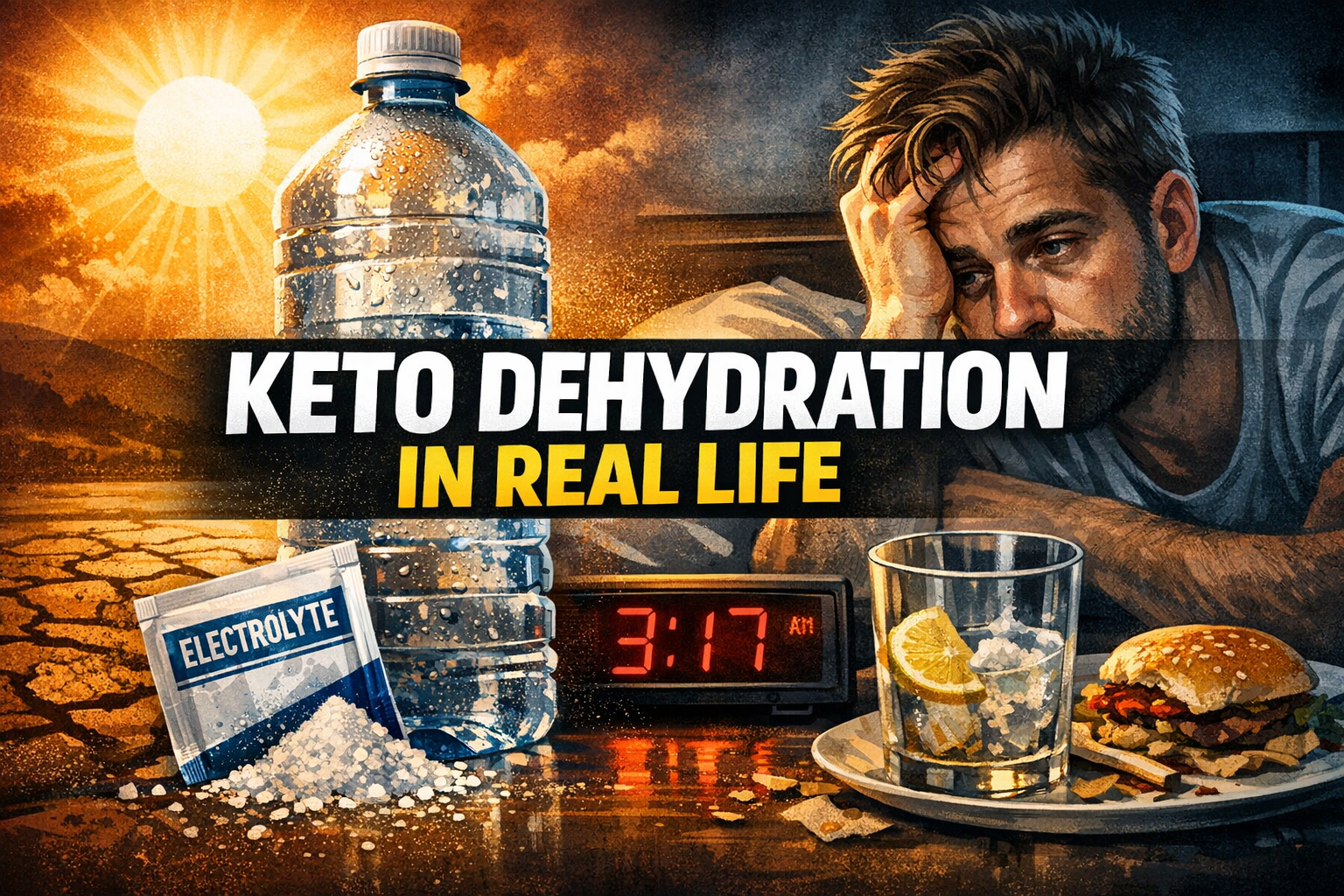
You think keto stopped working. Your body thinks you are dried out, under-salted, underfed, or trying to run on coffee after a rough night.
That is why dehydration on keto confuses so many people. It does not always feel like thirst. It can feel like a headache, shaky hunger, a pounding heart, a bad mood, lousy sleep, weak workouts, or a next-day crash that makes you want every easy carb in sight.
Here is the core reality check: keto lowers insulin, you drop water fast, and the usual margin for sloppy hydration gets smaller. If your sodium, fluids, meals, and timing are weak, real life hits harder. Heat hits harder. Alcohol hits harder. Long errands hit harder. A bad night of sleep hits harder. Even a long walk can feel way more dramatic than it should.
That is why this page is not just another electrolyte lecture. It is a practical map for the moments when keto dehydration shows up in normal life. If you need the basic foundation first, start with Keto Electrolyte Balance and Keto Electrolyte Problems. This page is for what happens after that, when the problem keeps showing up in different situations and you are tired of guessing.
Why keto dehydration gets missed so often
Most people wait for obvious thirst. That is mistake number one. Keto dehydration often looks more like a body-management problem than a dry-mouth problem. You wake up behind, drink caffeine first, eat late, sweat a little, stay busy, and then wonder why you feel weird by noon.
That is also why people keep misreading it as keto flu forever. Sometimes it is early adaptation. Sometimes it is just the same low-sodium, low-fluid pattern showing up again in a new outfit. If your symptoms keep repeating, the deeper explanation in Keto Flu Symptoms Explained usually makes the pattern obvious.
It can also turn into nausea or a racing-heart feeling before people connect the dots. If your mornings often start with coffee and very little food or salt, that crash pattern looks a lot like the one explained in Why Keto Makes You Nauseous and Why Your Heart Pounds on Keto.
Start here:
Situation 1: bad sleep makes dehydration feel worse the next day
Sleep loss shrinks your margin for error. After a rough night, people usually lean harder on coffee, forget food, eat later, and do a worse job noticing thirst. Then they call it cravings or low motivation when the body is really running stressed, dry, and underpowered.
That is why poor sleep and dehydration stack so badly. You are not just tired. You are more likely to skip the boring basics that would have stabilized the day. The full sleep-side-effects pattern is laid out in Keto Sleep Problems and Keto Side Effects After Bad Sleep.
Real life version: you sleep badly, wake up late, grab coffee, push lunch, and tell yourself you will catch up later. By midafternoon you feel off, maybe hungry, maybe headachy, maybe weirdly irritable. Then you start looking for something fast and salty and sweet at the same time. That is not random. It is the day unraveling in a very predictable order.
Situation 2: heat and summer routines drain you faster than you think
Summer is where a lot of keto plans stop feeling simple. You are outside more, your appetite gets weird, drinks replace meals, and salty structured food gets replaced by grazing. People think they are doing less because they are not in the gym. Meanwhile they are sweating through yard work, pool days, beach days, errands, kid stuff, and all the friction around being out of the house longer.
That is exactly why Keto Summer Survival matters. Heat does not just increase thirst. It changes how you eat, what you drink, and how easy it is to get behind without noticing. Once you are behind, the rest of the day gets louder fast.
If you already know your side effects show up more outside the house, the broader environment pattern in Keto Away From Home helps connect the dots. The fix is not heroic discipline. It is planning for boring things like fluids, salt, first meal timing, and what you will do before you get desperate.
This is where people get tricked by how normal the day looks. A baseball game, a couple of errands, some time outside, maybe a stop for groceries – none of that feels extreme. But stacked together, it can mean more sweating, more driving, more meal delay, and fewer chances to recover before you are suddenly making sloppy food choices at 7 PM.
Situation 3: alcohol turns one sloppy evening into a whole next-day mess
Alcohol is not only about carbs. It is also a dehydration multiplier. You drink, stay up later, sleep worse, eat later, maybe snack more, and wake up wanting quick relief. That relief often looks like greasy food, sweet drinks, random packaged snacks, or a full restart tomorrow. So one night becomes two damaged days.
That sequence is why Alcohol on Keto and the Keto Recovery Guide work well together. One explains the damage pattern. The other gives you a practical order of operations for the next day.
The common mistake here is chasing the hangover feeling with caffeine, skipping protein, and waiting until afternoon to get serious. That usually makes the hunger and shakiness worse. The better move is ugly but effective: fluids, sodium, actual food, and less drama.
Situation 4: active days do not need to look athletic to cause problems
A lot of people only plan electrolytes for workouts. That misses half the real-world problem. Long walks, yard work, warehouse shopping, sightseeing, moving boxes, chasing kids, and standing around in heat all count. They may not feel intense, but they still chip away at your fluids, sodium, and energy while also making meals later and sloppier.
That is why the pattern in Keto Side Effects After Long Walks catches so many people off guard. The issue is not that the body is broken. The issue is that the day quietly became more expensive than the food and fluid plan you brought into it.
Real life example: you call it a light day because it was not a formal workout. But you were on your feet for hours, you sweated, you ate late, and then you got home ravenous. From there, overeating or panic-snacking is not a mystery. It is a delayed payment.
A lot of readers also get in trouble because they use movement to justify less structure. They think, I earned something easy, or I will just grab something later. That turns a draining day into a convenience-food day, which usually means the recovery gets delayed again.
Situation 5: next-day hunger is often a hydration problem wearing a food problem mask
One of the most confusing versions of keto dehydration is the next-day hunger mess. You assume you need more willpower, more fat, or some magical keto snack. But what often happened was simpler: yesterday was undersalted, underhydrated, underfed, too caffeinated, too hot, too boozy, or too long. Today your appetite is noisier because the body is trying to close too many gaps at once.
That is why people who think they have a pure cravings problem sometimes need to read Keto Appetite Control and Keto Recovery Guide: What to Fix in the Next 24 Hours. Hunger is not always a sign that keto stopped working. Sometimes it is the bill from yesterday.
This is where most people make the wrong move. They either white-knuckle it and keep under-eating, or they swing into low-carb junk because they want something fast. Neither solves the original problem. If the day before was messy, your first job is to stabilize, not to prove discipline.
Another common misread is assuming you need more fat because keto feels shaky. Sometimes you do need a better meal, but buttering coffee harder does not fix a body that is behind on sodium, fluids, sleep, and actual food. A bigger version of the wrong fix is still the wrong fix.
The practical framework: fix dehydration like a system, not a symptom
Here is the part people skip. They try to patch one symptom at a time. Headache? More water. Cravings? Maybe a keto treat. Fatigue? More caffeine. That turns everything into a guessing game.
A better system is simpler. First ask what kind of day this is. Slept badly? Out in heat? Drinking tonight? Driving all day? Walking more than usual? Eating late? Once you know the day type, you can act earlier instead of waiting for the crash.
Then cover the basic sequence in order. Get fluids in. Get sodium in. Eat a real meal. Reduce the caffeine panic. Stop pretending a flavored drink or a handful of snack food is the same as recovery. This is boring advice, but boring is what works when your body is sending loud signals.
It also helps to think in pathways instead of symptoms. If the problem started after a bad night, follow the sleep pathway: earlier food, earlier sodium, less caffeine escalation. If it started after heat or a long active day, follow the exposure pathway: fluids, salt, a steady meal, and a calmer evening instead of drinks and snacks. If it started after alcohol, do not negotiate with the next day. Recover on purpose.
That is how this page should work for you. Not as a giant directory. As a start-here system. Find the situation, identify the pattern, then take the next practical step before the whole day gets noisy.
Related:
Common mistakes that keep repeating the same dehydration cycle
The first mistake is trying to fix everything with plain water. If sodium is the missing piece, more plain water can leave you feeling just as lousy or even more washed out.
The second mistake is waiting until symptoms are obvious. By then the day usually needs more than one quick fix. You may need food, salt, fluids, and less stimulation all at once.
The third mistake is thinking only workouts count. Real life is full of low-grade draining days that still need a plan.
The fourth mistake is treating the next day like a moral failure. If you had alcohol, heat, poor sleep, or a long active day, the answer is recovery, not shame.
The fifth mistake is using sweet convenience products as the answer to an unstable body. If you are dried out and underfed, fake treats usually add noise instead of relief.
The sixth mistake is treating every episode like a brand-new mystery. If it keeps happening after the same kind of day, stop searching for exotic answers. The pattern is the answer.
And the seventh mistake is trying to solve the problem socially instead of physically. People will spend twenty minutes arguing with themselves about whether they are really hungry while still refusing to drink, salt, and eat something solid. You do not need a debate. You need recovery basics.
Fix this first:
- Pick your highest-risk day types now: bad sleep, heat, alcohol, long walks, travel, or late-meal days. Those are the days that need earlier fluids and sodium.
- Stop using plain water as the whole plan. Pair fluids with enough sodium and a real meal when symptoms start building.
- After any messy day, do next-day damage control early: breakfast or lunch with protein and salt, steady fluids, and less caffeine drama.
- Keep one simple backup setup ready for outside-the-house days so errands, summer outings, and travel do not turn into dehydration plus random eating.
- If the same symptoms keep repeating, track the pattern by situation, not just by symptom. The trigger is usually the day structure.
If this helped, start with these next:
- Get the basic electrolyte setup right before you troubleshoot anything else
- See how bad sleep keeps side effects and next-day hunger running
- Use the next-24-hours recovery plan when the day already went sideways
Explore more Keto Problems & Side Effects stories here: