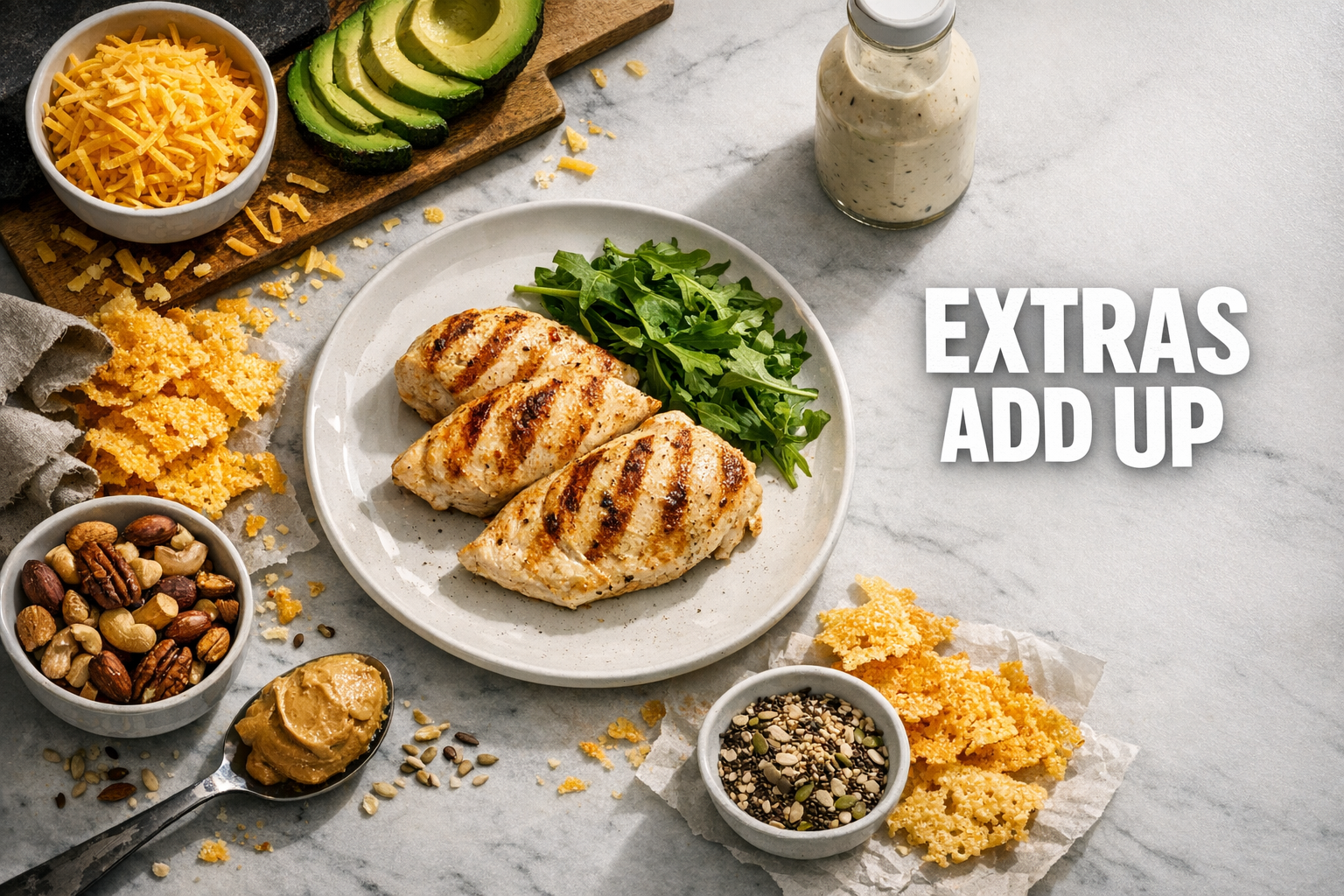
You can stay low carb all day and still make keto weight loss messy if every meal keeps picking up a few “healthy” extras on the way to your plate.
That is usually the part people miss. The meat and eggs are not the problem. The pile of shredded cheese, the heavy pour of dressing, the spoon of nut butter after dinner, and the crunchy keto topping “because it fits” are what turn a normal meal into a bigger one than you realize.
I’ve seen this happen with the kind of dinner that looks super disciplined from six feet away, then turns into a calorie pileup once the little add-ons show up.
If you’re dealing with healthy extras on keto, the issue usually is not one single ingredient. It is the stacking.
Why healthy extras on keto get confusing so fast
Keto teaches people to watch carbs. That part matters. But once a food gets labeled “keto-friendly,” a lot of people stop treating it like food that still counts.
That is how meals start drifting. A salad becomes chicken, cheese, avocado, dressing, bacon, seeds, and a handful of crispy toppings. Coffee becomes cream, butter, collagen, and sweetener. Yogurt becomes nut butter, coconut flakes, sugar-free chips, and chopped nuts.
None of those things are automatically bad. The problem is that the extras often add more energy than the actual meal while doing very little to improve fullness.
Start here:
1. Your meals stop being meals and turn into platforms for toppings
This is one of the most common ways keto gets messy. You start with a decent base like eggs, ground beef, chicken, or Greek yogurt. Then you keep upgrading it.
A little shredded cheese. A drizzle of sauce. Some sour cream. Maybe bacon bits. Maybe crushed nuts for crunch. Maybe a spoon of nut butter because the meal still feels “clean” enough to handle it.
In real life, it looks harmless because each add-on feels small. But several small extras can easily matter more than the base food. That is especially true when the base food is leaner or more portion-controlled and the extras are dense.
A good example is a taco bowl. Beef, lettuce, and salsa can be a simple meal. Add cheese, sour cream, avocado, chip-style cheese crisps, and a heavy pour of dressing, and now the “extras” may be doing more damage than the beef.
The mistake is thinking the meal is still simple because the ingredients are technically low carb. It is not simple anymore if every bite needs a bonus layer.
The fix is boring, but it works: build the meal first, then cap the extras. Pick one or two add-ons max. If the base meal would not satisfy you without a pile of upgrades, the base meal is too weak. Start there.
If this sounds familiar, read Why “Just a Handful” of Nuts and Cheese Can Stall Keto Weight Loss. It shows how small keto foods stop feeling small once they become routine.
2. You keep using “healthy” pours instead of real portions
This is where dressings, heavy cream, olive oil, and nut butter get people.
They are not junk foods. But they are easy to use without seeing them clearly. A quick pour into coffee is different from measuring it. A spoonful of dressing in your head is usually not the same as what lands on the plate.
That matters because liquid and spreadable extras stack fast. You can see a chicken thigh. You can count two eggs. But a casual pour of dressing or cream is easy to underestimate by a lot.
Here is what it looks like in real life: someone makes a “healthy” lunch salad, uses a lot of dressing, adds olive oil, adds pumpkin seeds, then finishes with extra cheese because the bowl looks too light. They still think they had a light meal. On paper, it may be the biggest meal of the day.
The common mistake is focusing only on whether the extra is keto-approved. That is the wrong question. The better question is: How much of this am I actually using, and is it helping me stay full?
The fix is to make invisible extras visible for a week. You do not need to obsess forever. Just stop free-pouring. Use a real spoon for cream and dressing. Put nut butter on the spoon instead of eating from the jar. If portion drift has been sneaking up on you, even a short reset helps.
That is also why “Healthy” Keto Sauces, Creamers, and Dressings That Quietly Stack Up All Day hits so many people hard. The small pours are usually not as small as they feel.
3. Crunchy add-ons make a real meal feel like a snack attack
A lot of keto meals start respectable and end like snack mashups.
You make eggs, then add cheese crisps on the side. You build a salad, then throw on a crunchy topping. You plate burger patties, then eat nuts while dinner cooks because you want something to hold you over. Then maybe dessert gets a keto topping too.
This changes more than calories. It also changes the feeling of the meal. Crunchy little extras can keep you in a “just one more bite” mode instead of a sit-down meal mode. That makes it easier to stay mentally snacky even when you are technically eating dinner.
A common pattern is someone who says they barely snack, but every meal comes with little crunchy keto sidekicks: nuts, crisps, trail mix-style add-ons, or low-carb dessert pieces. Those count. They also keep appetite stirred up.
The mistake is using texture as an excuse to keep adding food. Wanting crunch is normal. Building every meal around bonus crunch is how the extras keep multiplying.
The fix is to ask whether the meal needs crunch or needs a stronger base. Many times the reader who keeps chasing crunch is actually underwhelmed by a weak meal. More protein and a more satisfying portion help more than another keto topping.
If crunchy cravings keep showing up, read Why You’re Still Craving Crunchy Foods on Keto All Day. Sometimes the topping habit is covering up a bigger pattern.
4. Dessert-style extras turn normal food into a reward cycle
This happens a lot with yogurt bowls, chia puddings, cottage cheese bowls, and even coffee.
The base might be fine. Then the meal gets dressed up like a treat: sweetener, peanut butter, sugar-free chips, whipped cream, chopped nuts, coconut flakes, cinnamon, and one more little drizzle because it still fits keto.
That creates two problems. First, the extras add up. Second, your regular meals start training you to expect dessert energy all day. That can keep your sweet tooth switched on even when your carbs stay low.
In real life, this looks like someone who says, “I’m not cheating,” and they are technically right. But every snack or breakfast is built like a low-carb sundae. Then later they wonder why they still feel snacky, restless, and hard to satisfy.
The mistake is assuming that if sugar is low, the appetite side of the problem disappears. It does not always work that way. A meal can be low carb and still keep the reward loop running.
The fix is to separate nourishment from entertainment more often. Make more meals taste good without making every one feel like a keto treat. Use fewer dessert-style upgrades, especially earlier in the day.
That is one reason posts like “Healthy Keto” Foods That Quietly Sabotage Progress and Healthy Keto Protein Bars, Shakes, and Yogurt: Why They Can Make Keto Feel Worse Than Expected connect with so many people. The issue is not just carbs. It is the whole pattern around hyper-palatable extras.
5. You keep fixing weak meals with extras instead of fixing the meal itself
This is the real heart of the problem.
When a meal does not feel satisfying, many people do not increase the actual useful part of the meal. They keep adding little things around it. More cheese. More sauce. More cream. More crunch. More keto dessert after.
But if lunch was too light, toppings will not fully solve that. If breakfast had barely any protein, adding heavy cream to coffee will not solve that either. If dinner is mostly vegetables with decoration, you will still feel the weakness later.
The common mistake is using extras as a rescue plan. They are not reliable for that. A stronger base is.
The fix is simple: if you are hungry, make the meal more like a meal. Add more protein. Add a clearer portion. Make it easier to finish one solid plate and move on. That works better than turning every meal into a low-carb buffet.
If your meals often look clean but never actually settle your appetite, read Why Keto Feels Harder When Your Meals Look “Clean” but Never Actually Fill You Up. That problem and the extras problem feed each other.
The common mistakes that keep this going
Most people do not get stuck because of one giant keto mistake. They get stuck because these habits feel too small to matter.
- Counting carbs but not noticing repeated add-ons
- Treating cheese, cream, dressing, and nuts like free foods
- Building every meal for taste and texture instead of fullness
- Using dessert-style toppings so often that regular meals stop feeling satisfying
- Trying to rescue weak meals with extras instead of more real food
You do not need a perfect keto menu to fix this. You just need to stop letting the little upgrades run the whole day.
Fix this first:
- Pick one meal today and strip it back. Keep the base strong: protein first, simple sides second, one or two extras max.
- Stop free-pouring for one week. Measure cream, dressing, oils, and nut butter long enough to see what your normal “little bit” really looks like.
- Cut the crunchy and dessert-style pile-ons. If the meal needs five upgrades to feel worth eating, the meal needs fixing.
- Use extras on purpose, not automatically. Ask whether each add-on improves fullness or just makes the meal harder to stop eating.
🔎 If this helped, here are more no-BS keto guides worth reading next:
- “Healthy Keto” Foods That Quietly Sabotage Progress
- “Healthy” Keto Sauces, Creamers, and Dressings That Quietly Stack Up All Day
- Why Keto Weight Loss Slows Down When You Keep Adding Fat to Food That Was Fine Without It
Explore more Keto Lies & Myths stories here: