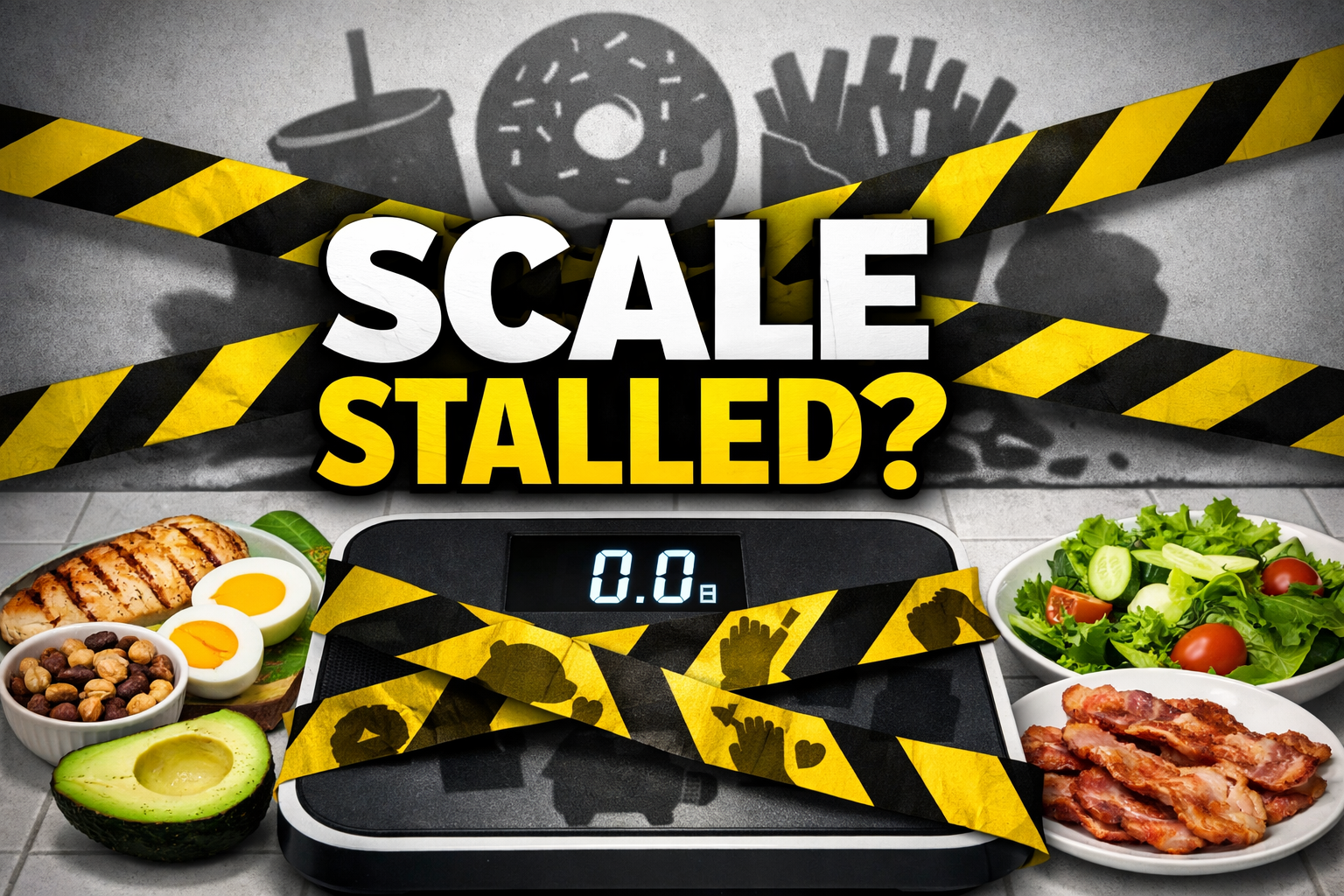
Not losing weight on keto usually does not mean keto stopped working.
It usually means a few small habits got sloppy enough to stall the scale.
That is the reality check. Most stalls come from low-carb routines that still look clean on paper but quietly drift in real life.
Portions get bigger. Snacks become more common. Restaurant meals show up more often. Packaged keto foods replace real meals. Fat gets added to everything. Protein stays too weak. Weekends quietly erase the progress built during the week.
The annoying part is that all of those habits can still look keto.
You can stay low carb and still create the exact conditions that stop weight loss.
This is not a random list of keto tips. This is a stall troubleshooting map. Start at the top, move through each section honestly, and find the biggest leak before you start changing everything at once.
If you want the broader stall overview first, read Keto Weight Loss Stalls.
Not Losing Weight on Keto? Start With This Quick Diagnosis
Start with the statement that sounds most like your real life.
| If this sounds like you… | Check this first |
|---|---|
| “My meals are bigger than they were a month ago.” | Portion creep |
| “I snack, taste, or graze between meals.” | Low-carb bites between meals |
| “My weekdays are fine, but weekends get loose.” | Consistency and weekend portions |
| “I eat takeout or restaurant food several times a week.” | Restaurant and takeout traps |
| “Most of my keto foods come from packages.” | The net-carb trap |
| “I add butter, cream, cheese, and fat to everything.” | Fat stacking |
| “I am always hungry or always thinking about food.” | Protein and meal structure |
If more than one sounds familiar, that is normal. Most stalls are not caused by one perfect problem. They usually come from two or three small problems stacking together.
The goal is not to fix everything today. The goal is to find the biggest leak first.
Step 1: Check Portion Creep Before Anything Else
If keto worked at first and then slowly stopped working, portion creep should be your first suspect.
Portion creep does not feel like overeating because it happens slowly.
The extra cheese becomes normal.
The larger steak becomes normal.
The second serving becomes normal.
The heavy pour of cream becomes normal.
The handful of nuts while cooking becomes normal.
Nothing looks wild. Nothing feels like a binge. But the daily total keeps drifting higher until the same keto routine no longer creates the same result.
This is why stalled keto can feel confusing. The food still looks low carb, but the amount of food has changed.
Signs Portion Creep Is Your Problem
- Your plates are larger than they were when keto was working.
- You often go back for seconds.
- Cheese, nuts, cream, oils, sauces, and dressings show up everywhere.
- You eat until stuffed instead of satisfied.
- You rarely feel real hunger before eating again.
The One-Week Test
For seven days, build your plate once and stop there. No second servings. No eating directly from bags, jars, or containers. Keep breakfast and lunch boring enough that you can actually compare one day to the next.
If the scale starts moving again, portion creep was probably doing more damage than you realized.
For the deeper version, read keto portion creep.
If your weekdays look controlled but weekends always stretch bigger, read weekend portions keto stall.
Step 2: Stop Ignoring Low-Carb Bites Between Meals
Many keto stalls are not caused by huge meals. They are caused by tiny meals pretending not to be meals.
A few cubes of cheese while cooking.
A low-carb bar in the car.
A spoonful of peanut butter at night.
A handful of almonds while cleaning the kitchen.
A few pork rinds because you are not “really hungry.”
These bites feel harmless because they are small and technically keto. But small does not mean invisible. Repeated enough, they can easily become the difference between losing weight and staying stuck.
The other problem is appetite noise. If you are constantly tasting, picking, and grazing, you never really learn whether your meals are doing their job.
You are not eating breakfast, lunch, and dinner anymore. You are running one long low-carb snack session all day.
Signs Grazing Is Your Problem
- You rarely sit down for a planned snack, but you keep grabbing bites.
- You taste food while cooking and cleaning.
- You keep “emergency” keto snacks everywhere.
- You eat because food is nearby, not because you are truly hungry.
- Your meals look fine, but the day still feels messy.
The One-Week Test
For one week, eat only planned meals. If you need a snack, plate it, sit down, and treat it like real food. No standing bites. No handfuls. No spoonfuls. No “just this one.”
If that feels harder than expected, that is your answer.
Start here: low-carb bites between meals.
If the pattern is more emotional, automatic, or routine-based, read keto routine breakdowns.
Step 3: Look at the Whole Week, Not One Good Day
A lot of people judge keto by their best days.
Monday was clean.
Tuesday was pretty good.
Wednesday lunch was perfect.
So when the scale is stuck, it feels unfair.
But weight loss does not care about the one meal you remember best. It responds to the full pattern.
This is where weekends become a problem. Not because weekends are evil, but because they often look nothing like the rest of the week.
Friday night turns into takeout.
Saturday becomes “still keto” but much bigger.
Sunday turns into grazing, leftovers, drinks, snacks, and a reset promise for Monday.
By the time the week is done, three strong weekdays may have been erased by two loose days.
Signs Consistency Is Your Problem
- You eat very differently on weekends.
- You are stricter after a loose day, then loose again later.
- You keep saying, “I was good most of the week.”
- Your plan depends on willpower instead of repeatable meals.
- You have no idea what an average week actually looks like.
The One-Week Test
Do not make your week perfect. Make it consistent. Similar breakfasts. Similar lunches. Fewer random snacks. Fewer restaurant meals. Fewer “it still fits keto” decisions.
You are not trying to punish yourself. You are trying to create a clean signal.
Once the week is consistent, the stall becomes much easier to troubleshoot.
Step 4: Audit Restaurant Food and Takeout
Restaurant food is one of the easiest places for keto stalls to hide.
Most people focus on the obvious carb swap.
No bun.
No fries.
No rice.
No tortilla.
That is a good start, but it does not tell the whole story.
Restaurant meals are usually larger, richer, saltier, and harder to estimate than meals made at home. Sauces can be sweet. Oils are heavy. Portions are oversized. Cheese, dressing, mayo, bacon, cream, and extras show up fast.
A meal can be low carb and still be much bigger than you think.
Takeout has the same problem, just faster. You order something that sounds safe, then it comes with hidden sauce, extra portions, breading crumbs, creamy sides, or enough food for two meals.
Signs Takeout Is Your Problem
- You eat out multiple times per week.
- You order “keto” but still feel overly full afterward.
- You rely on restaurant meals when busy or tired.
- You tell yourself the order is fine because there is no bun or rice.
- Your home meals work better than your restaurant weeks.
The One-Week Test
For seven days, keep restaurant meals to a minimum. Build simple home meals around protein first. If the scale moves, you do not need a complicated explanation. Your restaurant routine was probably heavier than it looked.
Read keto takeout mistakes that stall weight loss.
If you need better restaurant choices, use what to order at restaurants to stay keto and keep losing weight.
Step 5: Check the Net-Carb Trap
Packaged keto foods are where many stalls get sneaky.
The label says keto.
The front of the package says low carb.
The net carbs look small.
So the food feels approved.
That approval feeling is the trap.
Bars, wraps, breads, cookies, chips, desserts, drinks, and low-carb snacks can keep the old eating pattern alive. You may not be eating regular bread anymore, but you are still building the day around replacements, snacks, sweet tastes, and convenience foods.
Net-carb math is not magic. A food can fit the label and still make your plan harder to follow.
For some people, these foods trigger more cravings. For others, they encourage bigger portions because the food feels safe. Either way, they can keep a stall going.
Signs Net-Carb Foods Are Your Problem
- You eat keto breads, wraps, bars, or desserts most days.
- You trust the label more than your hunger response.
- You eat more because the food is “allowed.”
- Your cravings stay loud even though carbs are technically low.
- Your meals depend more on products than simple foods.
The One-Week Test
For one week, remove packaged keto replacement foods. Build meals from simple ingredients: eggs, meat, seafood, chicken, vegetables, cheese if it does not trigger overeating, and basic fats used normally.
If hunger and cravings calm down, the product lane was probably part of the stall.
Start with Net Carb Trap Map.
If bread replacements are the main issue, read keto bread and low-carb wraps keep you stuck.
Step 6: Stop Adding Fat to Everything
Some people hear “keto is high fat” and turn that into “add fat to everything.”
That is where things go sideways.
Fat can be part of a successful keto diet. But fat is not a weight-loss button. Adding more butter, cream, cheese, oil, dressing, bacon, sauces, and nuts does not automatically make a meal better.
Sometimes it just makes the meal easier to overeat.
A chicken salad can be reasonable. Add cheese, avocado, bacon, creamy dressing, nuts, and extra oil, and now it is a completely different meal.
Coffee can be simple. Add butter, cream, flavored syrup, collagen, and extras, and now it may be acting more like a meal than a drink.
This is not about fearing fat. It is about not adding fat just because the internet told you more fat means more keto.
Signs Fat Stacking Is Your Problem
- You add fat even when the meal already has enough.
- Your coffee is basically breakfast.
- Cheese, cream, oils, nuts, and dressings appear all day.
- You use fat to make every meal feel more keto.
- You are not hungry, but you still add more because it feels allowed.
The One-Week Test
For seven days, stop automatic fat stacking. Use enough fat to make food enjoyable, but do not upgrade every meal with extras. Keep meals simple and watch what happens.
Read adding fat to food on keto.
If drinks are part of the problem, check healthy keto drinks that stall weight loss.
Step 7: Fix Protein and Meal Structure
Not every stall comes from eating too much junk.
Some stalls come from meals that never actually satisfy you.
This usually shows up as constant hunger, snack thoughts, cravings, late-night kitchen trips, or the feeling that keto is technically working on paper but impossible to live with.
Protein matters here.
If your meals are light on real protein, you may spend the rest of the day trying to patch the hunger with cheese, nuts, bars, drinks, and random low-carb snacks.
That is not a willpower problem. That is a weak meal structure problem.
A strong keto meal usually starts with protein first. Then vegetables if you want them. Then enough fat to make the meal satisfying, not so much that it becomes a calorie bomb.
Signs Protein Is Your Problem
- You are hungry soon after meals.
- Your meals are mostly fat, snacks, salads, or keto products.
- You keep looking for something after dinner.
- You snack at night because the day never felt satisfying.
- You are trying to eat tiny meals and then fighting hunger later.
The One-Week Test
For one week, build every main meal around a solid protein source first. Do not start with snacks, fat bombs, drinks, or keto treats. Start with real food that holds you.
If cravings calm down, protein and structure were probably missing.
Read Keto Protein Problems.
If salads leave you hungry, read healthy keto salads still blow up hunger.
For the bigger meal system, read Keto Meal Structure That Actually Keeps You Full.
The Keto Stall Fix Order
Do not try to fix every possible problem at the same time.
That is how people burn out.
Instead, fix stalls in this order:
- Check portion creep.
- Stop grazing and low-carb bites.
- Compare weekdays to weekends.
- Reduce restaurant and takeout meals.
- Pause packaged keto replacement foods.
- Stop automatic fat stacking.
- Strengthen protein and meal structure.
Pick the first item on that list that honestly sounds like your life. Fix only that for one week. Then reassess.
Most people do not need a total keto restart. They need cleaner troubleshooting.
How to Troubleshoot Without Turning Keto Into Homework
You do not need to live with a calculator forever.
But if the scale has been stuck for weeks, you need a short reality-check window.
For three to seven days, make the plan boring enough to learn something.
Eat repeatable meals.
Limit restaurant food.
Pause packaged keto snacks.
Stop random bites.
Build meals around protein.
Do not change ten things every day.
The point is not perfection. The point is signal. If every day looks different, you cannot tell what is working and what is not.
Simple meals make the problem easier to see.
Frequently Asked Questions About Keto Stalls
How long is a normal keto stall?
A few days or even a couple weeks without scale movement can happen. Weight loss is not perfectly linear. The bigger concern is when the stall continues and your habits have clearly drifted.
Should I cut carbs even lower?
Not automatically. If carbs are already low, the problem may be portions, grazing, restaurant meals, packaged keto foods, weak protein, or weekends. Cutting carbs lower will not fix those problems.
Do I need to track calories?
Not forever. But a short tracking window can help if you truly have no idea where the stall is coming from. Many people only need a few honest days to spot the issue.
Is keto still working if the scale is stuck?
Maybe. But a stuck scale means something deserves review. Do not assume keto failed until you have checked portions, snacks, weekends, takeout, net-carb products, added fats, and protein.
What is the fastest thing to check first?
Portions and grazing. Those two problems are common, easy to overlook, and usually faster to test than changing your entire diet.
Related:
Related:
Reality Check: Keto Probably Did Not Fail
A stalled scale does not automatically mean keto stopped working.
Sometimes it means the routine changed.
Sometimes it means low-carb snacks became too normal.
Sometimes it means weekends are bigger than you want to admit.
Sometimes it means restaurant meals are doing more damage than the carbs alone show.
Sometimes it means your meals are too weak to control hunger.
That is frustrating, but it is also good news.
You probably do not need a detox, a magic supplement, or a dramatic restart.
You need a better troubleshooting order.
Start with the simplest explanation. Fix one leak at a time. Give each change enough time to show you something.
The scale is not always telling you keto failed.
Sometimes it is simply telling you where to look next.
Fix This First
- Pick the stall pattern that sounds most like your real life.
- Run the one-week test for that problem.
- Keep meals simple while troubleshooting.
- Stop changing everything at once.
- Use the child posts above when you find your biggest leak.
If this helped, start with these next:
- The main stall patterns most people miss
- The packaged low-carb foods that quietly keep stalls going
- Why meals that look fine still leave you hungry and stuck
Explore more Keto That Actually Works stories here: