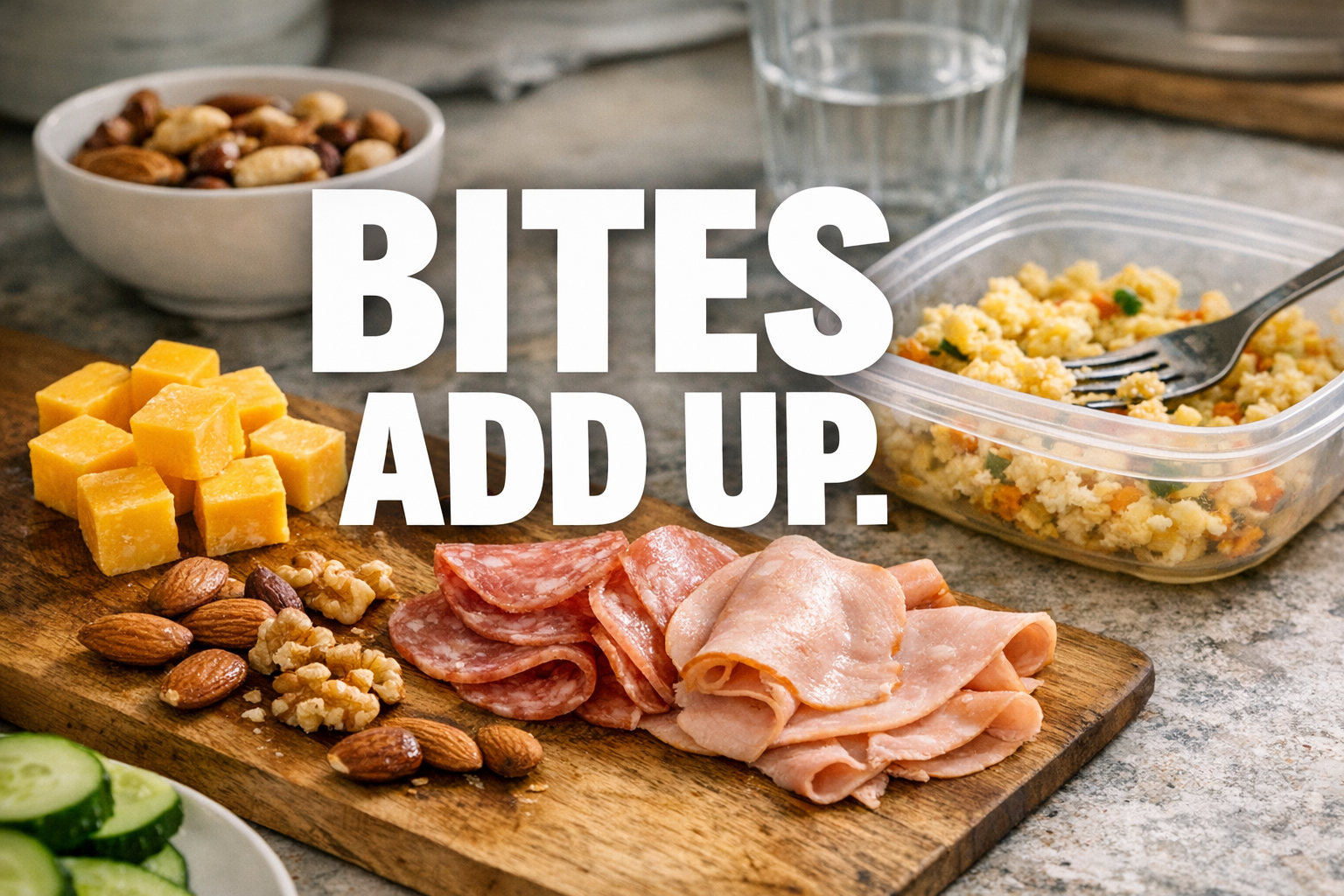
You stay low carb at meals, skip obvious junk, and still wonder why keto weight loss stalls. Then you remember the bites between meals: a few nuts here, a forkful there, a couple pieces while cooking, a quick desk nibble that barely felt real.
Here’s the truth. Those low carb bites between meals can quietly turn your whole day into one long eating window, and that makes progress a lot harder than people think.
I’ve seen this pattern before: breakfast and dinner look fine on paper, but the space in the middle gets filled with “small” food that never gets counted in your head. That’s where a lot of stalls start.
Why low carb bites between meals can stall keto weight loss
Keto usually works best when your meals are clear, filling, and easy to remember. When the day turns into random bites between meals, you stop getting that clean structure.
The problem is not always carbs. A lot of the time, it is appetite, portions, and how often you keep your body expecting more food. You can stay technically low carb and still make fat loss slower if you keep layering in enough extra energy to erase the gap your meals were supposed to create.
This is also why the problem feels confusing. You are not sitting down to a “cheat meal.” You are just grabbing little low-carb bites that never feel serious. But those little tastes on keto count whether you respect them or not.
Start here:
Cause 1: You keep eating while cooking, cleaning up, or finishing other people’s food
This is one of the easiest ways to stall without noticing. You make lunch, grab a slice of cheese. You cook dinner, eat some bacon, pick at the pan, finish a few leftovers, and maybe eat what your kid did not finish because it seems wasteful.
None of that feels like a meal. That is exactly why it becomes a problem.
In real life, this often looks harmless. You tell yourself it was “just a bite” or “barely anything.” But a few bites during meal prep can turn into several hundred extra calories before you even sit down.
The common mistake is thinking the only thing that matters is whether the food was keto. If it was bacon, cheese, eggs, deli meat, or nuts, people give themselves a pass. But weight loss does not care that the extra food fit the rules. It still counts.
The fix is boring, which is why it works. Stop free-eating while you cook. If you want part of the food, put it on the plate and count it as part of the meal. If you need something to hold you over while cooking, make it a planned mini plate instead of five random bites. That keeps the day honest.
Cause 2: Your between-meal food is small enough to ignore but frequent enough to matter
A handful of almonds at 11. A beef stick at 1:30. Two cheese cubes at 3. A spoonful of peanut butter at 4. Nothing sounds huge by itself.
Put together, though, that pattern can flatten the deficit you needed for fat loss.
This is where people get stuck for weeks. They remember the meals because meals feel official. They forget the filler food because filler food feels emotional, rushed, or automatic. That makes it easy to believe keto “just stopped working.”
Sometimes the issue is not even hunger. It is convenience. Food is nearby, the day is dragging, and grabbing something low carb feels safer than grabbing chips. Better choice? Sure. No consequence? Not even close.
A related trap is using foods like nuts and cheese as if they are bottomless. That is why nuts and cheese can stall keto weight loss so easily. They are easy to nibble, easy to underestimate, and easy to repeat.
The fix is to make the day more visible. For one week, every bite between meals has to go on a napkin, plate, or note in your phone before you eat it. You do not need to obsess forever. You just need to break the fantasy that all these mini snacks are too small to matter. Most people clean this up fast once they see the pattern in plain English.
Cause 3: You are trying to patch weak meals with random “safe” food later
A lot of between-meal nibbling is really a meal problem wearing a snack mask.
If breakfast was coffee and vibes, or lunch was a sad little salad with barely any protein, your afternoon will usually go sideways. Then you start patching the gap with anything that looks keto enough: jerky, cheese, nuts, spoonfuls, leftovers, bars, or bites from the fridge.
This is where people tell themselves they have a willpower problem. Usually they do not. Usually the earlier meal just was not strong enough to carry them.
Real life example: you eat a light lunch because you are busy and trying to be “good.” By 3 PM you are roaming the kitchen, opening drawers, grabbing little low-carb foods, and never quite feeling done. You might not eat one big bad thing, but you still end up eating more overall because the meal never really solved the hunger.
The mistake is trying to fix poor structure with random discipline. That rarely lasts. A better move is building meals that shut the door on the need to graze later.
Fix this by making your first two meals more complete. Get serious about protein, make the portion real, and stop pretending coffee counts as food. If this is happening earlier in the day, start with more protein early in the day. If it is a lazy-keto morning mess, use a repeatable breakfast like the ones in these lazy keto breakfasts that stop the mid-morning crash.
Cause 4: Desk bites, car bites, and standing-up bites do not feel emotionally real
Food you eat while sitting down at a real meal feels obvious. Food you eat while answering email, driving, cleaning the kitchen, or standing in front of the fridge often does not register the same way.
That matters because vague eating creates vague memory. If your brain barely logged it, you will not give it much weight when you think back over the day.
This is why someone can honestly say, “I barely ate anything today,” while leaving out the string cheese, jerky, almonds, deli turkey, and leftovers they ate on autopilot between tasks.
The common mistake is believing the issue is a lack of keto knowledge. Usually it is not. It is a lack of boundaries around when eating starts and stops.
The fix is simple: if you are not willing to stop and eat it on purpose, do not eat it. No standing bites. No driving bites. No “let me just grab this while I’m here” bites. Put food on a plate, sit down, and decide if it is a snack or part of a meal. That one rule kills a shocking amount of invisible intake.
Cause 5: You keep rewarding stress, boredom, or transitions with low-carb food
Not every between-meal bite is about physical hunger. Sometimes it is what happens when you switch tasks, hit a stressful email, finish work, or want a break.
Food becomes punctuation. You are not starving. You just want relief, stimulation, or a little reset.
On keto, this can be extra sneaky because the foods look “safe.” So instead of cookies, it becomes a few pork rinds, some cheese, half an avocado, a couple bites of leftovers, or a keto snack that seems harmless. The food changed, but the loop stayed the same.
The mistake is trying to fight this with pure resistance. If the habit is wired to certain moments, white-knuckling it rarely works for long.
The fix is to replace the cue, not just shame the response. When you notice the pattern, give those transition moments a default move that is not food: tea, sparkling water, a five-minute walk, gum, a short reset outside, or simply delaying ten minutes before deciding. If you are still genuinely hungry after that, eat a real planned snack. If not, you just interrupted a fake-hunger loop.
Common mistakes that keep this stall going
The first mistake is focusing only on carbs. Yes, carbs matter on keto. But if you keep eating all day in low-carb fragments, you can still make weight loss slower.
The second mistake is acting like every stall must be hormones, age, or a broken metabolism. Sometimes the answer is much less dramatic: your meals look fine, but the bites between meals are doing more damage than you want to admit.
The third mistake is over-correcting by trying to eat as little as possible the next day. That often backfires and leads right back to more grazing. If keto isn’t working, the answer is usually better structure, not panic.
Related:
Related:
What to do instead if you want progress to feel real again
You do not need perfect tracking forever. You do need a few honest days where meals are clear and extra bites stop hiding in the background.
When people tighten this up, they usually notice three things fast: hunger gets easier to read, random eating drops, and the stall starts making more sense. That alone is useful because now you are fixing the real problem instead of guessing.
If you already know your danger zone is the kitchen, make your meals bigger and your grazing harder. If your danger zone is work, stop storing open-ended snack food at arm’s reach. If your danger zone is afternoon stress, build a non-food reset before the first bite shows up.
The goal is not to be strict for the sake of it. The goal is to make eating visible again so your results stop getting buried under “small” choices that were never small when you add them together.
Fix this first:
- For the next 7 days, count every low-carb bite between meals instead of only remembering the main meals.
- Stop eating while cooking, driving, cleaning, or standing in the kitchen. If it matters enough to eat, plate it.
- Strengthen breakfast and lunch with more real protein so the afternoon does not turn into patchwork snacking.
- Pick one planned snack rule: either no snack, or one real snack eaten on purpose instead of constant grazing.
- Replace your biggest fake-hunger moment with a non-food reset before you decide you actually need to eat.
If this helped, here are more no-BS keto guides worth reading next:
- Why “Just a Handful” of Nuts and Cheese Can Stall Keto Weight Loss
- Why Keto Feels Harder When You’re Not Eating Enough Protein Early in the Day
- Keto Isn’t Working? The Real Reasons (And What Actually Fixes It)
Explore more Keto That Actually Works stories here: